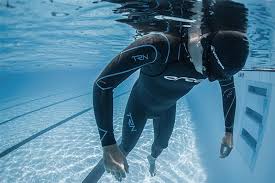
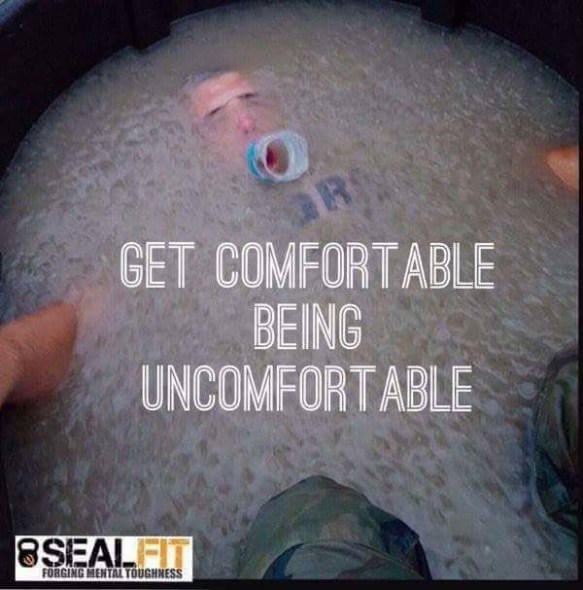
Tonight’s Freediving drill is about becoming comfortable being uncomfortable.
It’s about learning to relax when the body and the mind want to freak out.
Marco a very experienced freediving instructor is our coach for this evening and it’s all about building up C02 in the body and learning to relax into it when the body is screaming for us to breath.
The desire to breath isn’t as much about needing oxygen as it is realising Co2.
In states of apnea, such as freediving, the body is unable to regulate the increase of CO2 by moderating the intensity and frequency of the breathing cycle. Thus, the body signals the brain that there are increased levels of CO2 in the bloodstream (hypercapnia), creating the urge to breathe.
For freedivers, the urge to breathe often manifests itself as a burning sensation in upper portions of the chest or in the form of contractions/convulsions of the diaphragm directly under the ribcage.
Despite these feelings, which can be overwhelming and unnerving for untrained divers, there is no need to panic as these are only signs that the levels of CO2 in the bloodstream are increasing and there is still plenty of usable oxygen remaining in the system.
The ability to recognize your personal limits and tolerance to increased carbon dioxide levels is something that will be developed over time and with practice. Ultimately dive times can be increased by training the body to tolerate higher levels of CO2. ( Explanation was taken from https://www.theinertia.com/health/understanding-your-physiological-urge-to-breathe-when-youre-underwater/)
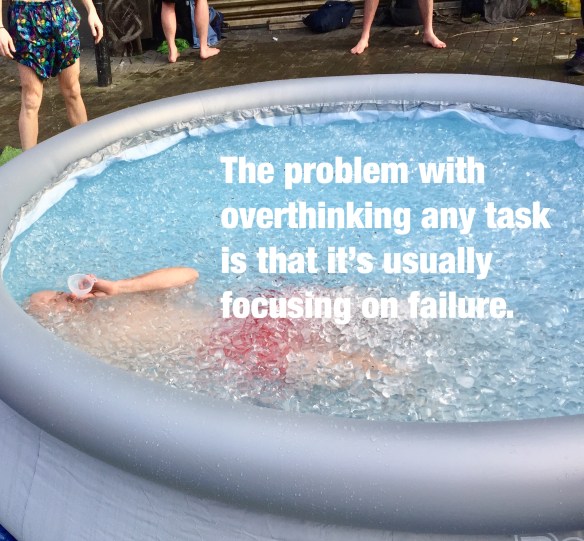
As I mentioned in one of my other post https://younglobal.wordpress.com/2018/09/10/id-rather-not-who-cares-what-youd-rather-not/ the desire to do well, or more accurately not fail is a strong driver. Wanting to succeed brings with it, the temptation to find ways to ‘go easy’ so we don’t find ourselves falling short of a perceived outcome and feeling crappy about ourselves.
Especially in the case of a novice free diver like myself, it’s hard to override the desire to make every apnea length rather than the thought of over exerting myself too much and not being able to complete the length, which gives the impression of success. Getting to the end feels good. Popping up half way feel like failure.
In freediving terms it’s not, but in real life, default hardwired thinking it does! That’s what we are conditioning. To override the default.
Because freediving, especially in my club, is about contradictions.
We are often succeeding when we believe we are failing.
When we have to surface early its better than fighting through, purely as a feedback mechanism. We are training our brain to be in the moment and to relax not reach a destination that causes both anxiety but also barriers to growth.
Because it’s not about completing one length, is about comfortably doing 4,5,6 or 8, who knows. But it’s about training the brain to be comfortable and relaxed in the moment and not about trying to make a distance. The distance will come as a bi product of being relaxed. By striving for the distance we are rarely relaxed and therefore fail to get as far as we could do.
And then to contradict point, we then want to train ourselves to be stressed and very uncomfortable but then learn to become comfortable in that state.
To force our body to crave a release but to deny it by learning to acknowledge and accept and control those sensations and emotions.
One exercise Marco had us doing this particular night that demonstrates this, was one in which we want to learn to control the natural desire to breath mentioned earlier from CO2 build up rather than need for oxygen.
We swim 50 metres with no fins as quick as we can and then on the count of 20, which isn’t enough for full recovery, we lay face down in the water and attempt to hold for 1 minute.
Instantly you put your head down your heart beating in your chest lets you know you are not ready. Then your mind kicks in. Everything is saying I’m not going to make this. Then the thoughts of not wanting to fail or to quit kick in. The desire not to be beaten or to be the first to break is adding to the sense of panic.
And despite this, this is where I want to be. This is the simulator. This is where we go to work on ourselves. This is where we grow.
By noticing your physiology and releasing the tension, slowing the internal dialogue down and changing it, by taking your mind somewhere else and way form the pain. It’s leaning to accept it and change the perception of the pain, instead of trying to escape the discomfort.
And like all things everything’s about training and conditioning. What I’ve just written is true for me, but it’s just theory to you if you don’t do this. It’s an ideal.
The only way to really understand it is to do it. To practice. To feel it and to know your protocols for failure and for success.
And even knowing what I know, it’s not an infallible system and I regularly break before time..
In this example I came up 5 seconds before the time for the first attempt. I was annoyed because if I knew I could have made it….well once I knew it was just 5 seconds more!
But it’s the ‘not knowing’ thats the head fuck and where part of the training and learning lies. To have no end goal, no time frame and still be able to hold in there.
And it’s also about acknowledging that when you think you are done, as Ex Navy Seal and super human David Goggins says ‘when you think you are done, you are really only 40% done’.
Once I realised I’d come up short I dug a little deeper next time and made the rest of the sets.
It hurt like hell but it was within my capability.
And it’s also about understanding that the Human default is to getting away from pain and towards pleasure. And because of this we often move away from the very things that will, in the long term, make us much happier.
My mantra when I get to my pool sessions is ‘I’m here to train not feel good’.
And what I mean by that is that I want to get better.
And if I want to get better I’ve got to get uncomfortable.
I’ve got to be prepared to meet myself out there both mentally and physically.
To recognise when I’m trying to run away or coast along just so I can remain inside the bullshit persona we all concoct about ourselves in an attempt give the illusion of being better than we really are and essentially feel good.
To listen to my internal dialogue when it’s getting rattled or angry and to look at what’s really going on. It’s about accepting all of that and also recognising my outcome and why I want it.
I imagine a rope tethered to an end point. And when all the other shit is going on I just concentrate on pulling myself along the rope and try to ignore the barrage of other crap that coming in on me.
Getting comfortable about being uncomfortable isn’t about being unbreakable or being indifferent to our emotions. It’s not about learning to be an automaton or a psychopath.
Learning to be uncomfortable and accepting the discomfort is about self-recognition. Of seeing where the cracks are. Of being present to who we are and all our vulnerabilities and short comings.
But even more importantly it’s about recognising, using and developing our strengths.
Those parts of us that are our values, our principles and our underlying character that we rarely get to see when we play it safe or never feel pain.
Like the contradictions in freediving, being able to embrace who we are and who we want to be is equally about being willing to step into the parts of us that we don’t want to be reminded of and the parts that show us we are not perfect by any means.
It’s inside of these spaces and overcoming weakness with strength do we become the person we can respect.
 tonktraining.com