Controlling Your Breath for Performance and Health
“It’s funny, but you never really think much about breathing. Until it’s all you ever think about.”
– Author Tim Winton
There is no doubt that you have heard of employing some type of breath control to improve your performance, your state of health, or to reduce stress. Moreover, it probably isn’t a stretch to conclude that controlling the amount of air you move is far better than just letting your subconscious brain do what it likes.
What’s missing is any understanding. Most of the advice I’ve heard through the years is some variation of “breathe deep” or “slow it down” but without a set of principles or instructions. Even the mental health professionals I work with understand the importance of controlling the breath but lack in their recommendations of how to do this.
Practice With Purpose
To some, the concept of practicing breathing sounds strange; after all, we do it without thinking, so why deliberately practice it? The answer is breathing is a skill, and like any other, when we purposely train it in an intelligent manner, our ability to do it without thinking improves.
There are a number of techniques that accomplish this, but the overarching theme to all of them is to consciously practice moving less air. All methods require you to manipulate the variables of the volume and the rate of your breathing; in other words, the amount of air you inhale, the time spent exhaling, and the length of the pause after the exhalation.
The primary goal of any properly organized breathing practice is to reduce your subconscious ventilation rate. You may have other goals in mind, but they are secondary to creating a higher level of tolerance to carbon dioxide as this is what reduces the subconscious ventilation rate. Pavel’s Second Wind seminar teaches participants many ways to breathe more effectively during physical activity, and how to relax afterwards.
Understanding Oxygen—When Less is More
Moving less air may seem contrary to grabbing more oxygen (O2) from the environment but, as it turns out, O2 delivery is less determined by ventilation and is more closely associated with carbon dioxide (CO2) retention. The primary driver of ventilation is not a lack of O2, as is commonly thought, but the accumulation of CO2.
You are literally a CO2 making machine, and respiration is how the body removes excess CO2 from the blood, which also helps to maintain systemic pH levels. Maintaining normal physiologic levels of CO2 is critical for health and performance during physical activities. Hyperventilation is defined as ventilating more than is required to remove excess CO2 from your system, and this is crucial to understand.
Hyperventilation—When More is Less
Don’t be fooled; hyperventilation is not just of the obvious brand, when someone is in immediate need of breathing into a brown paper bag—it also occurs at marginally low levels. Hyperventilation, of whatever degree, is the human response to almost everything that happens to us: emotions, movement, perceived threats, injuries, etc. The breathing center of the brain tracks the level of CO2 in the blood and increases ventilation as CO2 levels increase—this is normal.
However, the more you hyperventilate above the metabolic need to rid the body of excess CO2, the more you expose the breathing center to lower levels of CO2. Over time, this causes the ‘CO2-ostat’ in your brain to become dialed toward ‘more sensitive’. This results in your subconscious ventilation rate being set to ‘high’, meaning that in response to both small changes of CO2, and a lower level of CO2 in the blood, you move more air than is necessary. It’s no wonder then, if left unchecked, that breathing can get out of control.
Train your Brain, Reset your Breath
Retraining, or normalizing your breathing requires you to expose your breathing center to higher levels of CO2, so it can reset the CO2-ostat to ‘less sensitive’. The simplest way to do this is to consciously sit, relax and slow down your breathing. Second Wind covers several more advanced techniques.
Decreasing the rate of breath without changing the depth will reduce your total airflow. Over time, with concentrated practice, you will find that you can breathe slower and slower, all while not at all feeling like you are starving for air. This leads to a reduction in subconscious ventilation.
Moreover, it results in normalizing your CO2 levels in the blood, correcting pH, and delivering more O2 to the brain and tissues. It should come as no surprise that when you increase O2 delivery to highly aerobic organisms they find improved function and, clinically speaking, this improvement is drastic.
Breath, Health and Performance
Among the other benefits of increasing your CO2 levels, O2 delivery is probably paramount. O2 hitches a ride on hemoglobin of the red blood cell, and this is how it is carried through the blood out to the tissues in need. O2 and hemoglobin have an affinity for each other, not unlike magnetism. In the presence of more CO2, this affinity is weaker, allowing O2 to separate from hemoglobin, resulting in better delivery to tissues. However, if CO2 levels are reduced, this affinity is stronger, effectively damming O2 outflow from the blood, reducing the net delivery to tissues.
This phenomenon—the Bohr Effect—can be found in any physiology textbook and is not at all debated against. Over-breathing reduces both the delivery and tissue consumption of O2, driving down your performance and health.
Control and Relaxation
Some of the other benefits of improved CO2 levels due to normalizing breathing are mostly due to increased parasympathetic activity:
- increased oxygen delivery to tissues from the blood (Bohr effect)
- reduced blood pressure and heart rate
- balanced blood pH
- blood vessel and air passage dilation
- metabolic function improvements
- reduced nervous system excitability (reduces anxiety)
- improved brain function
- respiratory center sensitivity changes (easier breathing during activity)
- stabilized blood sugar
- improved immune function
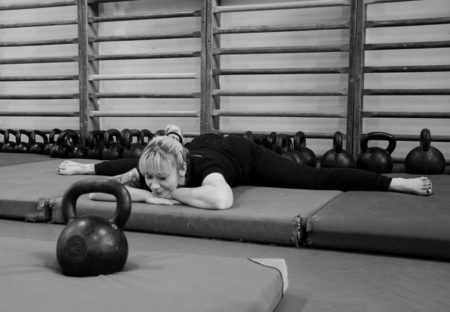
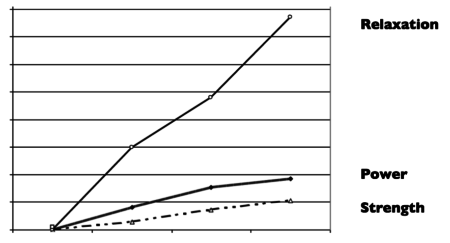
Again, this is textbook physiology that is not in debate. Implied but not mentioned, and clinically evident, is a better state of relaxation. Your muscles will not feel as tense; you will increase your range of motion about the joints as your brain relaxes its grasp; and you may even find relief from some of those knots and trigger points that you’ve been dealing with for years.
Remember, it should be no surprise that a highly aerobic organism functions better when you improve O2 delivery; and this coupled with decreased nervous system excitation can lead to unexpected pain relief. All simply due to controlling your breath.
Worse yet, if you’re over-breathing at rest, you are most certainly over-breathing during activity. In fact, you will find that you can not only breathe easier during exercise by practicing breath control at rest, but you will reduce the biological cost of that training session. There will be a significant reduction of blood lactate production during activity and you feel less muscle burn, less intensity, and recover faster in between training sessions. More frequent training—that you can recover from—is one hallmark of improved performance.
Breath and Strength
Over the years, I have personally gone from uncontrolled mouth breathing to nasal-breathing only, and then on to a formalized practice. With each change in the control of my breath, I found almost immediate performance and recovery benefits as well as health improvements.
I am at the point now that I can nasal-breathe through my entire five-minute snatch test with 28kg. Even if you do not yet appreciate the importance and power of controlling your breath, you can relate to the difference between breathing like a strong and healthy human animal (nasal only), and a sick or dying one (mouth breathing).
Just remember the implied goal of breathing retraining: reducing subconscious ventilation—the breathing you do while your mind is elsewhere.
How to Sync Your Breathing for More Kettlebell Power
By Brett Jones
Director of Education | StrongFirst
Kettlebell ballistics have very little to do with the kettlebell—and everything to do with how you move your body.
When it comes to rhythmically repetitive power work like swings, snatches, and cleans, your best performance comes when you’ve synced your breath to the movement pattern.
Better, more athletic swings mean you get more out of your training time and practice.
“Rhythm and timing are the two things which we all must have, yet no one knows how to teach either.” Bobby Jones
Bobby Jones was referring to the golf swing, however, there are many athletic movements that come together via rhythm and timing.
Serving in tennis, batting in baseball, throwing (whether a ball, punch or kick), and of course, our kettlebell ballistics.
The swing, clean, and snatch can all be examples of rhythmically repetitive power work. Properly timed they are athletic, crisp, and (dare I say) beautiful.
What coordinates the rhythmically repetitive aspect of the swing is the timing of the breath with a forced exhale at the hip extension and a sharp inhale during the hike or eccentric action of the movement.
The hip action of the swing is the hip action of the clean and the snatch, so for simplicity’s sake, we will focus on the swing.
Breathing Strategies
Your breathing pattern should “match” your goal.
For example, for stretching and relaxation, we use what is known as an anatomical breathing match.
As the body gets compressed (think leaning forward to stretch the hamstrings), air is released or forced out.
As the body extends, air is drawn in (think standing up from a toe touch and inhaling). For the strength, stability, and power of the swing, we use the biomechanical breathing match.
A biomechanical breathing match means we inhale while getting compressed (creating intrabdominal pressure) and exhale while extending (resulting in a more stable and braced finish).
Once the correct breathing match or strategy is identified—biomechanical in the case of the swing or hip action of the ballistics—we want to sync up the rhythm of the breath to the pattern of the movement.
To create the intrabdominal pressure needed for stability during the eccentric loading (which can reach 2.5-3x bodyweight or more), we need to time our sharp nasal inhale for just before the full eccentric action occurs.
A brief breath hold happens as the reversal of the movement occurs.
This rapid deceleration and redirection of force in the swing is just one reason it is such a power exercise.
Then on the hip extension, a forced exhale will occur as the hips fully extend. This can begin prior to the full hip extension but should “finish” timed with the extension of the hips. I like to think of getting trapped between my glutes and abs at the top of the swing so air gets knocked out.
Enjoy the float. And as the arms reconnect to the ribs and the eccentric action begins again, the breath cycle will repeat. See the video (you never know when someone is recording you in slo-mo).
The rhythm and timing get out of sync when the exhale is late, timed not with the hips but when the kettlebell reaches its finish.
For the swing, this could mean an exhale when the arms and kettlebell are at shoulder height or in the snatch it means the exhale is timed for the overhead lockout.
These mistimed exhales can also indicate a lack of connection of the arms to the body during the ballistics.
A lack of connection of the arms to the body during hip extension results in a loss of power.
The only way to get the full energy and power of the hips to transfer to the swing or snatch is to keep the arm(s) connected to the body until the power from the hips actually “pops” them off.
Just like cracking a whip, if the sequence gets disconnected then there is a loss of power and efficiency.
Sync your breathing and find the rhythm and timing in your kettlebell ballistics.
 tonktraining.com