
We have all had those times in life when we get presented with a task that, at face value seems too much for us to contemplate achieving.
We slam the door in the face of the idea and shout profanity’s through the letterbox until it goes away.
Eventually, when the moment has passed and we have got away with not answering the door to growing pains, we can get back up and continue with our mediocre unchallenged existence, complaining to anyone that will listen how we are bored.
Its often not the case that we are incapable of doing the task presented to us, but rather its how we perceive it as a snap shot, usually in its entirety, in full technicolor and a perfect showroom finish.
To illustrate this idea, a friend of mine recently enrolled in a new science based college course.
During his first few weeks he has had to get familiar with cellular biology.
Part of this biological soiree has required him to draw some 3d images of cells and label them as part of his course work.
This was not a task he was not relishing, due to his lack of belief in his skill with a crayon mixed with the seemingly complex construction of the diagrams he would need to replicate.
It was due to this Complexity of plant and animal cell illustrations that he remarked he was really struggling to commit to put pen to paper and getting it done.
A friend of mine who runs very large electrical projects once said to me about the multiplicity of some of the circuitry he was dealing with that really ‘everything’s just a switch’ and ‘a hotel is just a repetition of one room. If you can do one room you can do 100.’
As I’ve also written before about when things seem to grandiose for us to entertain, its often worth taking the time the break the request down into smaller units before we slam that door on potential to grow and improve.
I’ve got a design background and a lot of the type of art and design work I do has a strong leaning towards a 3d appearance, so I offered to help.
Initially my friend point blank said ‘No I want to do it myself.’
But still hearing the lack of enthusiasm in his voice, and not liking to turn away from a challenge, I asked him Show me the drawings.
I’m not going to do it for you, I said, but I can sort of ‘see’ in 3D.
Not because I have X-Man like abilities, but because, similarly to when an optical illusion is explained to us, once we see the other image, we can always see it from then on.
Likewise with learning to draw and sculpt, we begin to seeing how things go together three dimensionally as we construct then or reverse engineer them.
My experience just meant I could simply break it apart into easier shapes or ways of seeing, rather than seeing it as the finished computer generated example.
I see the illustrations as components. He was seeing them as a seamless and seemingly complex whole.
For example
The basic shape of a animal cell is sort of like a circle with a heart in the middle with a line drwan through the middle.
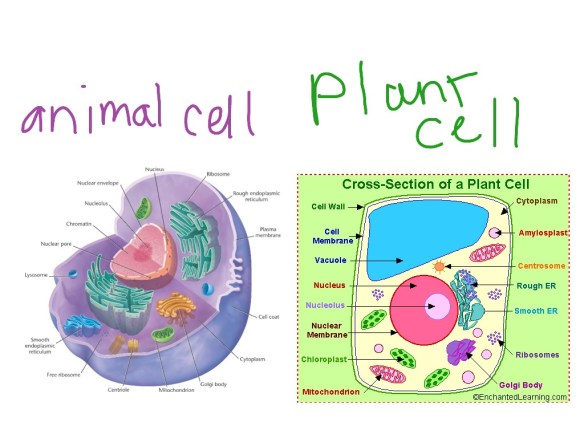
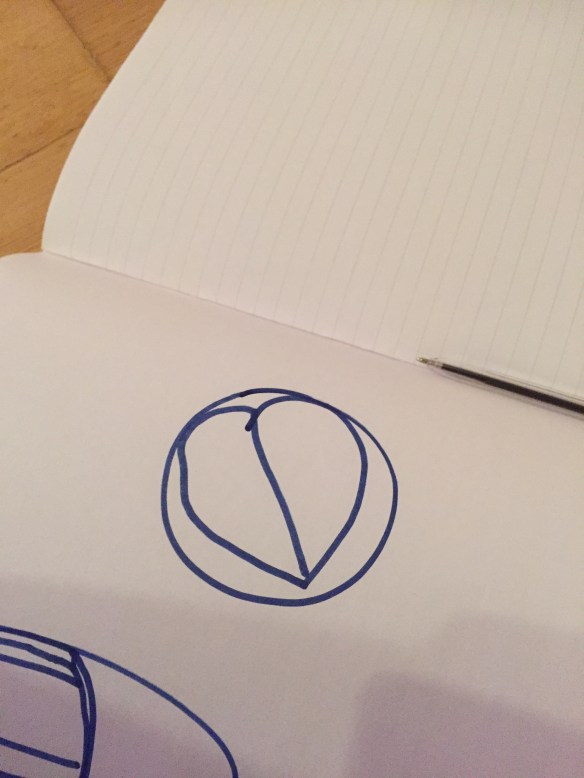
This is – crude I admit – but a circle with a heart in it with a line drawn through the middle are shapes we all know how to draw already. Its a lot easier to explain something when its relates to something we already know.
We did this to several others and their components.
I wasn’t telling him how to draw it. I wasn’t even telling him a final solution or the actual way he should go about it.
I was simply showing him a different way to see the bigger picture.
That’s what I attempt to do with my own challenges or if I’m working professionally with someone on something that’s causing them confusion or discomfort.
It’s a lot easier to see your way out of a problem when it’s been broken apart and laid out.
Looking at it from these perspectives we are much more likely to step back and then, with the skills we do have, formulated a plan.
Once we’ve had time to process the information it’s more likely we will be able to construct a clearer way of doing something.
Several days later he did it his own way with relative ease.
Whether it had anything to do with my crude illustrations of miraculous and complex cellular architecture I don’t know.
I haven’t asked.
Maybe it’s more correlation than causation or indeed a necessity to get it done due to a deadline that really made the shift and put pencil to paper.
A friend recently said to me, ‘for someone like you who dislikes ambiguity in preference to a more clinical trial set of black and white results, you have chosen a field that has many more questions than it has tangible answers.’
Whether anything specific the therapist or coach orchestrates, does actually grease the wheels towards desired change, its often hard to conclude, even for the person making those changes.
But there’s no doubt as I’ve written about before, breaking complex or seemingly solid issues down helps massively to break the freeze and fawn or Fight and Flight response.
And asking and being willing to see someone else’s perspective of a problem, or of ourselves, is also a quick way to resolve what often appears to be an insurmountable event or challenge.


Wise and helpful post. That Electrician friend of yours ‘sounds’ smart! Who knew?! ;o)
LikeLike